


We wrote this article this week (Aug 20) and lo and behold we just got the answer:
We just wrote a piece asking who ultimately eats the exploding memory bill inside Vera Rubin. Today’s news gives us the answer: the customer. AI server prices are reportedly going up more than 15% in many configurations shipping early next year, including Vera Rubin and Grace Blackwell, with the increase varying by memory content. Nvidia is not going to absorb HBM4 and SOCAMM inflation and sacrifice gross margins. The higher cost is being pushed through the rack. Great news for the memory vendors (we think?), and further evidence that Nvidia’s pricing power remains pretty ridiculous? (we think?)


August 20th, 2026:
We have wondered about this forever with NVIDIA. It is the largest HBM customer on the planet, yet rising memory prices—even if negotiated well in advance—have never seemed to leave a mark on gross margins. Either Colette Kress is a magician, NVIDIA’s pricing power quietly absorbs it all, or there is more gross-margin volatility ahead than the market appreciates. The truth is that gross-margin dollars matter far more than the percentage, but investors are thinking as shallow as a puddle these days—so we stress-tested the assumptions.
HBM Is Not an NVIDIA Margin Problem—Yet
The cost increase looks manageable through FY27. Rubin and FY28 ask a much harder question about NVIDIA’s pricing power.
Said no one yet: HBM is suddenly the easiest way to construct an NVIDIA gross-margin bear case? Memory prices are rising, HBM content keeps increasing with every accelerator generation, and Rubin moves NVIDIA into a more expensive class of memory while the company is still promising margins in the mid-70s. Put those together and it sounds like an obvious problem.
Before making it next quarter’s problem, though, it helps to run the math. HBM is already the largest component inside the B200, yet it remains a surprisingly small piece of what NVIDIA charges for the finished product. That spread explains why a cost increase that would be existential for a server OEM has so far been manageable for NVIDIA—and why the real debate probably belongs in FY28 rather than next week’s print.
Start With the B200
NVIDIA does not manufacture HBM, but the memory absolutely runs through its financial statements. The company’s 10-K explicitly includes “memory and component costs” in cost of revenue and “the cost of purchased memory products” in inventory. NVIDIA buys the memory, has it integrated alongside the GPU through advanced packaging, and sells the finished accelerator or system. HBM is not separately invoiced to the customer, but its cost sits inside COGS and is monetized inside NVIDIA’s selling price.
The useful starting point is Epoch AI’s B200 teardown. Epoch estimates that a B200 costs roughly $6,400 to produce, including 192GB of HBM3E at approximately $15 per GB.
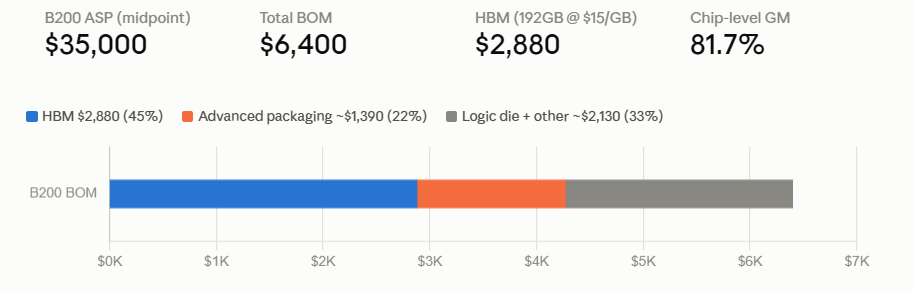
HBM is 45% of the B200 BOM, but only 8.2% of its assumed selling price. That gap is the entire story. NVIDIA is not trying to earn a server-OEM margin on a commodity component; it is charging for the performance and scarcity of the completed accelerator.
What a 20% HBM Increase Actually Does
Samsung and SK Hynix reportedly raised HBM3E pricing by nearly 20% for 2026 deliveries, an unusual increase for a memory generation that would normally be getting cheaper as its successor enters the market. The direction is not debatable: memory input costs are rising while NVIDIA is putting more memory into each new platform. The size of the immediate margin problem is less obvious.
A 20% increase in the B200’s estimated HBM cost adds $576 to the BOM.
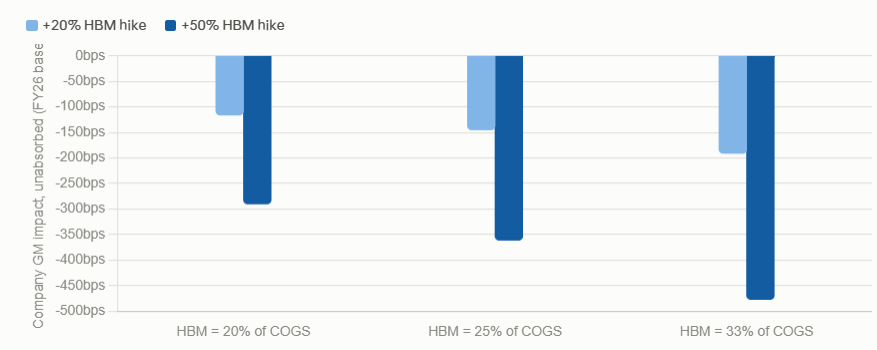
The middle line is the one that gets missed. Even if NVIDIA passes through every incremental HBM dollar, gross-margin percentage still declines because it is adding revenue at zero incremental gross margin. Gross-profit dollars are protected, but the percentage moves lower.
To preserve the original 81.7% chip margin, NVIDIA must raise price by approximately $3,150 against only $576 of additional HBM cost. In other words, every $1 of incremental memory cost requires roughly $5.47 of additional revenue to keep the margin percentage unchanged.
That is the pricing-power assumption sitting inside “mid-70s.”
The Rubin Stress Test
The memory cost does not need to double simply because HBM4 pricing rises. Public estimates use different stack sizes, capacities and contract assumptions, making many of the per-GB comparisons misleading. The better way to think about Rubin—and especially Rubin Ultra—is as a combination of more memory per accelerator and a more expensive memory generation.
If total HBM cost per GPU eventually doubles, the B200 framework changes quickly:
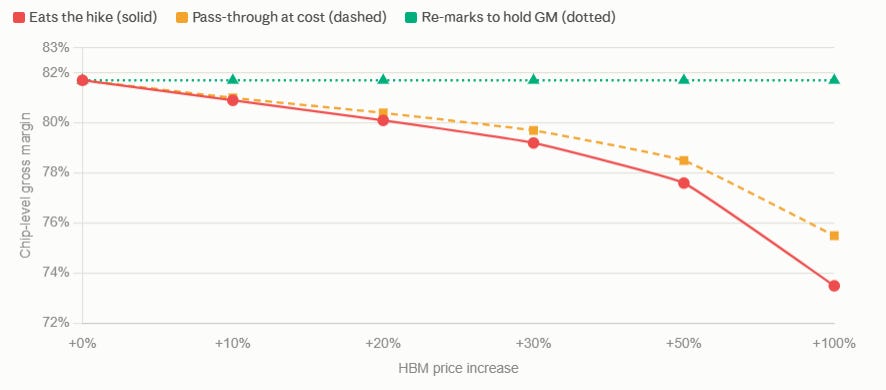
This is not our literal Rubin forecast. It is a stress test showing how much of NVIDIA’s margin depends on re-marking the extra content rather than merely recovering its cost. At B200 economics, an at-cost pass-through protects gross-profit dollars but pulls the chip margin almost directly into the company’s mid-70s range before adding lower-margin racks, networking, power and cooling content.
What It Could Mean at the Company Level
NVIDIA does not disclose HBM as a percentage of COGS, so this part must remain a sensitivity rather than a reported fact. FY26 revenue was $215.9B and COGS was $62.5B. If HBM represents somewhere between 20% and one-third of total company COGS, the unabsorbed impact looks like this:
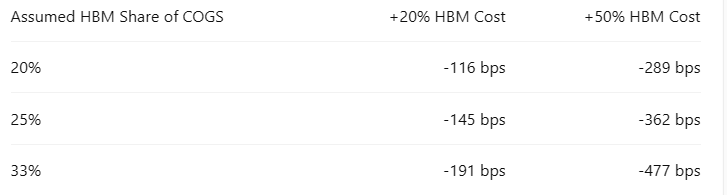
At the middle assumption, a 20% increase costs approximately 145 basis points of company gross margin if NVIDIA absorbs it. Starting from the recent 75% run rate, that alone takes margins into the mid-73s before cost reductions, mix improvements or repricing. At +50%, “mid-70s” no longer works arithmetically without substantial offsets.
Again, this is not guidance. NVIDIA does not disclose the HBM share, and company margins include far more than the accelerator BOM. The point is to show where the sensitivity begins to matter.
Why It Has Not Shown Up Yet
The market is not oblivious to this. Stacy Rasgon asked Colette Kress about memory and other input costs on the Q3 FY26 call. Kress acknowledged “input prices that are well-known in the industries” and said NVIDIA would rely on cost improvements, cycle time and mix to hold gross margins in the mid-70s. Jensen added that NVIDIA forecasts, negotiates and secures supply “well in advance.” The exchange is here.
The balance sheet supports that claim. NVIDIA ended FY26 with $95.2B of manufacturing, supply and capacity commitments, up from $30.8B a year earlier, with substantially all expected to be paid through FY27. That does not mean $95.2B of fixed-price HBM, but it does show how far forward NVIDIA has been planning and purchasing.
The margin results have also held. GAAP gross margin moved from 73.4% in Q3 FY26 to 75.0% in Q4 and 74.9% in Q1 FY27, while NVIDIA guided Q2 to another 74.9%. Memory inflation did not disappear during that period; NVIDIA offset it through some combination of pricing, product mix, procurement and manufacturing improvements.
It is also worth separating the HBM question from last year’s margin decline. FY26 gross margin fell to 71.1% from 75.0%, but NVIDIA attributed that primarily to the shift from Hopper HGX products toward full-scale Blackwell systems and the $4.5B H20 inventory and purchase-obligation charge. More racks, networking, power and other system content dilute the chip margin even without an HBM shock.
The Actual Bear Case
The bear case is not that investors forgot HBM sits in COGS. It is that NVIDIA’s ability to hold the mid-70s requires the company to keep charging substantially more than the incremental cost of the memory it adds. Thus far the hyperscalers have just told Wall Street to raise their capex like for like for higher memory costs.
That has been easy enough while customers are buying every accelerator NVIDIA can ship and judging the product on performance per watt rather than BOM. It becomes more interesting when Rubin and Rubin Ultra increase memory content again, HBM4 and HBM4E contracts reset, and customers have more credible price references from AMD accelerators and internal ASICs.
In fact, the forward wrinkle is this: B200 carries 192GB of HBM3e, while Rubin moves to 288GB of HBM4—50% more memory before accounting for the HBM4 premium. Rubin Ultra could be up to 1T of HBM. Rubin ASPs and final BOMs remain too fluid for false precision, but the direction is clear: HBM dollars per unit are heading north and likely becoming a larger percentage of the total BOM. In other words, our B200 stress test may be the easy version.
The $95.2B commitment balance and NVIDIA’s long supply visibility should protect FY27 better than a simple spot-price analysis suggests. FY28 is where those protections begin to roll into new memory generations and much higher content. If TPU and ASIC comparisons are louder by then, NVIDIA may still pass through the added dollars—but not necessarily at the markup required to preserve its margin percentage.
NVIDIA reports Q2 FY27 on August 26. We would listen less for another generic commitment to the mid-70s and more for how far that commitment extends into Rubin, whether supply coverage also means meaningful price protection, and how much of the offset is expected from cost improvements versus product pricing.
HBM is not likely to break next week’s margin guide. The more useful question is whether NVIDIA can still re-mark a structurally larger memory bill once customers have somewhere else to go.